The Many-Futures Enterprise series · Paper 1 of 8
The Many-Futures Enterprise
Planning Under Uncertainty
An enterprise can make one accountable operating commitment without pretending that only one future remains plausible.
1. The Monday Planning Meeting
The Monday planning meeting opens with a number no one disputes: Notional Electronics holds more of its current-generation product than it expects to sell before the replacement launches in eight weeks.
Sam (Sales) proposes a promotion. Every week of delay will make the old inventory harder to sell and leave less room for the new generation.
Mary (Marketing) objects immediately, “That’s a fire sale. A visible discount so close to the launch tells customers that the current generation is obsolete and trains them to wait for promotions.”
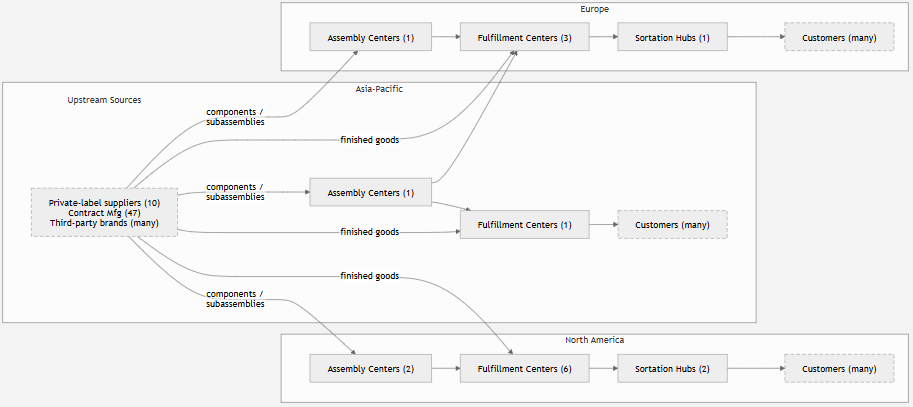
Tonya (Transportation) points to the network map. “A worldwide promotion changes the expected regional mix of demand. If we wait for an updated forecast, we can reposition inventory. If we don’t wait, we’ll pay for more air freight. Alternatively, we could relax the delivery promise on promoted items to reduce transportation expense.”
Omar (Operations) responds, “I can batch the repeatable work of reconfiguring units for their destination regions. Product customization is different: if the promotion includes customized models, that will consume benches and labor reserved for the new generation launch. A relaxed promise would let me fit that work into gaps as they open.”
Fiona (Finance) supports the promotion with a condition: “Let’s get the cash out of the old generation, but not if freight, customization, and delayed sales of the new generation destroy more value than holding the old inventory.”
On the screen, the cursor blinks beside the empty field labeled PROMOTIONAL QUANTITY. Everyone needs the number by noon.
At 8:52, the field contains a number. Sam updates the sales plan, Mary releases the campaign, Omar calls the staffing agency, Tonya reserves transfer capacity, and Fiona updates the financial outlook. Before noon, every plan shows the same promotional quantity.
2. The Meeting Worked
Seen from above, the meeting did what planning meetings are supposed to do. Five perspectives challenged one another, the team chose an executable quantity, and the decision reached every function before its deadline. The team was neither paralyzed nor confused. It made a rational commitment with the evidence available on Monday.
The common quantity did not mean that the five participants had adopted a common view of the future. Sam still saw aging inventory and a closing sales window. Mary still saw a discount weakening the replacement launch. Tonya still saw a choice among waiting for an updated forecast and repositioning inventory, accepting more air freight, or relaxing the delivery promise. Omar still saw two product generations competing for the same configuration capacity. Fiona still saw cash trapped in the old generation, but not enough upside to justify every way of releasing it.
Their agreement settled what Notional would do. It did not settle which of those beliefs would prove most correct. But an operating commitment is not the same thing as certainty about the future.
When reconciliation preserves only the approved plan, alternatives disappear from the active planning system. Their assumptions become harder to see, their consequences become harder to compare, and the organization becomes less prepared when evidence begins pointing toward a future it did not authorize for execution.
3. The Single-Future Assumption
Enterprises have made real progress replacing disconnected spreadsheets, inconsistent definitions, and competing versions of historical facts with common data and a shared source of truth. That discipline is valuable.
One history does not imply one future.
Historical claims can be tested against evidence; competing future assumptions cannot be settled that way in advance. Forecasts and plans necessarily encode assumptions about events that have not happened, their consequences, and the actions the enterprise might take in response.
4. Many Futures Are a Feature, Not a Failure
Uncertainty creates disagreement because reasonable people can interpret an unknowable future differently. Those interpretations are hypotheses about what may happen and what the enterprise might do in response.
Those hypotheses need not be equally credible. One may reflect experienced judgment and deserve to remain the operating assumption. Others may be unlikely, incomplete, or unconventional. Representing an alternative does not require giving it equal resources, credibility, or decision authority.
However, preserving the alternatives and the reasoning behind them retains the ability to learn. As new evidence arrives, the enterprise can compare what each future assumed with what is actually emerging. Confidence can shift without reconstructing discarded alternatives or pretending that the preferred view was always the only plausible one.
5. The Cost of Pretending There Is One Future
Operational excellence rightly treats unnecessary inventory, capacity, and time as waste. Better information and better planning can reduce those buffers. But there is a limit: the future is not merely difficult to predict. Before it happens, it is unknowable. As efficiency approaches the theoretical optimum for one future, resilience to other futures can deteriorate nonlinearly.
The answer is not simply more buffer. When uncertainty is represented only as error around one authoritative plan, protection tends to be blunt: extra inventory, capacity, lead time, or conservative commitments against the general possibility that “the number” is wrong.
Multiple explicit futures can make that protection more precise. The enterprise can ask which alternatives create material exposure, where they differ, and which options are worth preserving until uncertainty resolves. Upside demand might justify flexible capacity; uncertain product mix might justify postponed configuration; supplier risk might justify inventory of one constrained component rather than inventory everywhere. The deeper cost of pretending there is one future is lost optionality. Uncertainty must be paid for somewhere. Better planning does not eliminate that cost; it lets the enterprise choose more deliberately where and how to pay it.
6. What a Many-Futures Enterprise Does Differently
A Many-Futures Enterprise does not replace one authoritative plan with a collection of equally weighted scenarios. It separates what the enterprise chooses to do from what it remains willing to consider. The goal is not one version of the future, but one governed system for evaluating many plausible futures.
This extends scenario planning rather than replacing it. Planning systems already support scenarios, versions, and what-if analysis. The distinction is not whether multiple futures can be represented, but the status they have in ordinary enterprise reasoning. In a Many-Futures Enterprise, alternatives are first-class participants in everyday planning, not merely analytical artifacts created when someone decides to run a what-if. An enterprise already using scenario planning this way may be partway there.
Alternative futures persist after one becomes the operating assumption. They remain recomputable in seconds through the models that produced them, can be translated into comparable cross-functional consequences, and are governed separately from the commitments authorized for execution. Their assumptions, consequences, and rationale are preserved so that new evidence can strengthen the preferred view, increase confidence in an alternative, or justify creating another.
A future is more than a forecast. It combines beliefs about what may happen with the constraints, choices, and consequences that determine how the enterprise would respond. Preserving a forecast without beliefs and response logic preserves a prediction, not a future.
Persistence means more than saving a copy of the output. A future remains connected to the authoritative history from which it began; the evidence and assumptions that distinguish it; the constraints, choices, transformations, and decision rules applied to it; the consequences calculated across the enterprise; the people and authority involved; and the evidence that would justify reconsidering it. Reasoning can be captured conversationally when the decision is made, while its source, context, and relationships are still known. As evidence or commitments change, the future can then be advanced and recomputed in seconds rather than reconstructed later by asking people or AI to interpret detached meeting notes and build a new plan.
Those futures also need to be comparable without being identical. Sales, Marketing, Operations, Transportation, and Finance may reason differently, use different models, and organize the business around different concepts. A function may own one model, consume several, and contribute tacit context or informal influence that no formal model completely captures. The goal is not to force those perspectives into one worldview.
Explicit relationships among their concepts stored in the planning system allow a future expressed naturally in one function to reveal its implications in another. A financial guardrail can constrain inventory; the inventory position can change supply requirements; supply availability can change what Sales may credibly offer; and transportation capacity, timing, and cost can change all of them. Evidence propagates selectively through the relationships it affects, not indiscriminately into one master model.
Comparison requires more than visible outputs. The assumptions, transformations, and decision rules that produce each future must remain inspectable and traceable so that differences can be understood rather than merely observed.
Plurality requires strong governance. Ownership, access, credibility, resources, and decision authority remain explicit. An unconventional hypothesis does not receive equal standing simply because someone can express it, and exploring an alternative does not change what the enterprise has committed to do. The objective is not to preserve every imaginable future, but to preserve decision-relevant alternatives while their information value exceeds the cost of maintaining them.
Strong governance also changes how much exploration the enterprise can tolerate. Strong governance makes cheap experimentation safe at scale. When creating and testing an alternative becomes inexpensive enough, the threshold for exploration can fall dramatically. Ideas that would not justify a major project or a challenge to established judgment can still justify a cheap experiment.
That matters because established judgment can be very good without being infallible. Most experiments may confirm what experienced leaders already believe. Occasionally, however, someone elsewhere in the organization will see something the prevailing view missed. The enterprise can discover the exception without weakening the authority that produces the right answer most of the time.
Cultivate disagreement because insight can emerge from anywhere.
There is a second return even when the unconventional idea is wrong. People develop judgment by exercising it, confronting their hypotheses with evidence, and seeing why they succeeded or failed. Cheap experimentation therefore develops the enterprise’s capacity to reason about the future as well as its capacity to discover unusual insights.
Eventually, action still requires commitment. Leadership must decide what to buy, make, move, and sell. A Many-Futures Enterprise can make that commitment decisively without requiring the other futures to disappear. It can commit to one course of action while remaining prepared to learn that another future is becoming more plausible.
7. What the Team Recorded at 8:52
Before the field fills at 8:52, five departmental plans sit beside it. Each is already a rollup. Sam’s sales plan is driven by regional forecasts. Omar’s operations plan comes from assembly- and fulfillment-center workloads. Tonya’s transportation plan models the supplier and intra-network movements required by Omar’s workload plans and calculates the corresponding transportation-capacity reservations. Mary and Fiona have equivalent detail behind the campaign and financial outlook.
None of the five plans describes the decision the team has just made, so none is tagged for execution. Instead, the team opens Sam’s worldwide-promotion plan and selects Branch. Because the branch operation occurs within the meeting, the system branches all five input plans. Each new plan retains its lineage to the departmental plan from which it branched. The five new plans are also connected to one another and to the meeting as representations of the same proposed enterprise future. All five source plans remain intact.
The team modifies the connected branches. The promotion will run only in regions where excess units of the old generation are already positioned. Sam revises the quantities by region, and Mary narrows the campaign accordingly. As they save their changes, the five branched plans recompute. Omar sees the regional reconfiguration work, customization hours, and temporary labor calculated by the operations model. Tonya sees the remaining transfers and capacity reservations calculated by the transportation model. Fiona sees the cash released, margin surrendered, and expected effect on sales of the new generation.
Mary opens the chat window attached to the meeting and writes what would ordinarily become a meeting note: I support limiting the promotion to regions where the inventory is already positioned. A worldwide discount this close to launch risks making the old generation look obsolete and teaching customers to wait for promotions. Reconsider if a competitor discounts worldwide, the launch moves sooner, or the promotion delays the new-generation launch.
The system responds with a structured summary for Mary to review. It identifies her as the author, links the note to the meeting decision and the coordinated branch set, and records that her reasoning supports the limited promotion under current conditions. It captures her assumptions about price perception and cannibalization; creates a worldwide competitor discount, an earlier launch date, and a promotion-driven launch slip as separate evidence signals; applies the relevant products, regions, and planning horizon; and connects those signals to the affected demand, capacity, and financial consequences.
Mary confirms the summary. Her single paragraph becomes dozens of linked database records, each carrying its source and relationship to the meeting, decision, and plans. She does not have to populate dozens of fields or translate her reasoning into someone else’s data model.
The others add their reasons in the same way. Sam records his judgment that every week of delay narrows the viable sales window and increases the risk that old inventory remains when the new generation launches. Omar records that the limited promotion is operationally feasible, but customization will remain the bottleneck. A relaxed delivery promise will let Operations fit the work into gaps as they open; expanding the promotion could displace launch work. Tonya records that waiting for an updated forecast would improve inventory positioning but consume some of the remaining ground-transfer window. After that window closes, the team will have to accept more air freight or a longer delivery promise. Fiona records the economic guardrail: releasing cash from the old inventory remains worthwhile only while the combined effects on margin, transportation expense, and new-generation sales cost less than continuing to hold it. Each participant writes in the language of their own function. The system connects their judgments to the demand quantities, bench hours, labor requirements, inventory movements, transportation capacity, costs, margins, and deadlines calculated by the corresponding models.
The recomputed branch set remains within the transportation, capacity, and financial limits the team has agreed to use. Sam selects Submit for authorization. The participants whose approval is required receive a request, review the recomputed consequences and recorded reasons, and approve the coordinated plans.
After the final approval, the branch set and its five departmental plans change status to Authorized. Only those plans can release campaign spending, hire temporary labor, reserve transportation capacity, or change customer commitments.
At 8:52, the total promotional quantity from the authorized branch set fills the approval field. Sam releases the authorized sales plan, Mary releases the campaign, Omar calls the staffing agency, Tonya reserves transfer capacity, and Fiona publishes the updated financial outlook. Before noon, every executing plan shows the same promotional quantity.
The five source rollups—including Sam’s worldwide-promotion plan—remain visible as Not selected and unchanged, preserving the inputs as they existed when the meeting began. The meeting decision and the coordinated limited-promotion branch set retain the participants’ recorded reasoning, evidence conditions, economic guardrails, and deadlines. Only the coordinated limited-promotion branch set is marked Authorized.
8. Wednesday Changes the Evidence
On Wednesday morning, a competitor announced a worldwide price reduction on a comparable bundle.
The announcement did not prove that Sam had been right on Monday. It changed the evidence. A worldwide discount that had risked signaling obsolescence now looked more like a competitive response. The Monday decision remained rational: the team had made the most responsible commitment supported by Monday’s evidence.
Notional did not wait for the following Monday meeting. The system advanced the worldwide-promotion plan from Monday’s shared history, incorporated the regional campaign work already under way, and recomputed the consequences. It routed each recomputed departmental plan to its accountable owner, who could approve it or raise an objection.
Mary could see that the competitive signal had changed the meaning of the offer without erasing the risk to the replacement. Omar could see the additional bench hours, labor, and facility work required to expand worldwide. Tonya could see which transfer capacity remained available and which movements would now cost more. Fiona could compare the additional cash release with the updated margin and launch exposure.
The recomputation did not force every signal into every model. The competitor announcement changed the commercial assumptions. Those assumptions changed the promotional quantity and geography. The changed offer altered Omar’s configuration work, Tonya’s movements, and Fiona’s margin and cash exposure. History remained shared; consequences propagated through the relationships that made them relevant.
The worldwide promotion was more expensive on Wednesday than it would have been on Monday. Two days of lead time had been consumed, some inventory work had begun, and some capacity had been committed. It was still drastically cheaper than reopening the question the following Monday, after ordinary staffing, campaign, and ground-transfer options had expired. Another week could convert more of the response into overtime, premium transportation, deeper markdowns, or lost sales.
After all the departments approved their individual plans, the system assembled the coordinated set and routed it to the relevant team members for enterprise approval. They reviewed the combined consequences and authorized the worldwide-promotion future on Wednesday. Only then did Mary expand the campaign, Omar change the labor and facility plan, Tonya reserve the remaining transfer capacity, Sam update the offer, and Fiona revise the outlook.
The physical pivot still required work and money. The planning pivot did not require the team to reconstruct Monday’s discarded reasoning before the cheaper options disappeared.
The point is not that the team should have predicted Wednesday on Monday. No planning method makes an unknowable event knowable in advance. Wednesday’s evidence should not force the team to recreate Monday’s alternatives before it can respond.
9. Decision Resilience
The capability Notional demonstrated is Decision Resilience: the capacity to make and revise timely, accountable commitments as evidence changes, while preserving useful options before they disappear.
Forecast accuracy remains valuable. A more accurate view of the future can improve decisions, reduce unnecessary buffers, and help the enterprise commit resources with greater confidence. But planning quality cannot be judged only by the accuracy of the original prediction. It must also be judged by the enterprise’s continuing capacity to make good decisions as the future reveals itself.
Persistent alternatives make that capacity systematic. When new evidence arrives, the enterprise does not have to reconstruct the reasoning it discarded during reconciliation. It can compare the evidence with previously stated assumptions, see which futures are gaining or losing credibility, understand how its exposure changes, and determine which options remain available.
A resilient decision is not one that never needs revision. It is one whose assumptions and consequences are understood, whose worthwhile alternatives remain visible, and whose course can be changed with clear authority and traceability. The enterprise can commit decisively without making its ability to learn depend on having predicted perfectly.
This changes the standard for planning quality. The question is not whether Monday’s participants predicted Wednesday. It is whether they made the most responsible commitment available on Monday, preserved the alternatives still worth considering, understood when those alternatives would become more expensive or disappear, and responded promptly when the evidence changed.
It also changes the executive question. Instead of asking only, “What is the forecast?” leaders can ask: What must we commit to now? Which uncertainties matter to that commitment? What options should we preserve while they remain affordable? What evidence would justify changing course?
A Many-Futures Enterprise does not eliminate uncertainty. It develops the resilience to act within it.
The goal is not one perfect decision. It is the capacity to keep deciding well.
Where to Go Next
Paper 1 is the common foundation. Papers 2–7 are independent paths; choose the one that matches what you want to understand. Paper 8 brings the complete system together.
- To explore the deeper operating model behind Notional’s Monday and Wednesday decisions, read Many Futures, One Decision — coming soon.
- To understand why every plan is a selective reduction of reality and how software shaped the enterprise future, read Planning Is Modeling: How Software Came to Shape the Enterprise Future — coming soon.
- To decide when preserving an alternative creates more value than cost, read The Economics of Optionality: When to Commit and When to Keep Futures Open — coming soon.
- To understand how functions can retain their own models while producing comparable enterprise consequences, read Different Models, Comparable Consequences: Reasoning Across Enterprise Worldviews — coming soon.
- To explore the architecture required to preserve one history, persistent branches, and separate execution authority, read One History, Many Futures: The Architecture of Branching Time — coming soon.
- To see how AI can generate and challenge hypotheses without becoming operational truth, read AI Needs Somewhere to Be Wrong — coming soon.
- To see how the pieces fit together and what ChronoCone is being built to support, read Many Futures, One System: Why Solving the Parts Does Not Solve the Whole — coming soon.
If this paper was useful, please like or share it on social media, or send a copy to a friend.
© 2026 Kevin Finley — kevin@timecone.ai
About the Author
Kevin Finley has spent more than three decades building enterprise planning software, from classroom scheduling at CARS Information Systems and a large-scale Manugistics implementation to labor and logistics planning at Amazon. He began developing ontologies in 1996 and has continued that work throughout his career. At Amazon, he designed and led the development of two large-scale labor and logistics planning platforms that together produce more than 50,000 plans per day and have delivered more than $14 billion in savings. Separately, a self-initiated data analysis led to more than $400 million in savings. He is now the founder of Timecone.ai, where he is developing ChronoCone and the Many-Futures approach to enterprise planning.
Frequently Asked Questions
Can current scenario-planning tools already do this?
Some can do parts of it. Saving multiple scenarios is only the beginning. The test is whether each alternative remains a coordinated cross-functional plan set connected to shared history, source models, participant reasoning, evidence conditions, calculated consequences, and separate execution authority. It must also advance and recompute through those same relationships when evidence changes. If your tools do that, you are already partway there.
Won’t branches multiply without limit?
No. Keep a branch only while it could still change a material decision and useful evidence can arrive before the relevant option expires. Retire it when the decision closes, the option expires, or maintaining it costs more than the information it preserves.
Won’t this slow planning down?
Monday becomes 10–20 minutes slower so Wednesday can become much faster. Participants must expose the assumptions, objections, and option-expiration points that materially affected the decision. Making that reasoning explicit lets them compare assumptions across functions, expose conflicts, and test the proposed decision before they commit. Once encoded, the assumptions and decision rules can also be backtested against historical and subsequent evidence.
The goal is not to capture everything in their heads or make them maintain the graph manually: they speak in ordinary language, the system proposes the structure, and they review it. Those added minutes buy better immediate decisions and faster responses when evidence changes: less reconstruction, fewer repeated meetings, and fewer delays while options expire. Across many meetings, those minutes also buy a growing evidence base that data science can turn into enterprise learning. Paper 2, Many Futures, One Decision, develops the operating model behind Monday’s added work and Wednesday’s faster response.
Does this work outside online retail, and who gets a seat at the table?
Yes. Notional’s retail network makes demand, inventory, capacity, transportation, and cash visible in one example, but the method applies anywhere multiple functions must commit under uncertainty. Manufacturing, healthcare, energy, services, hospitality, real estate, and capital planning all face that problem.
In this example, transportation can change what the company can promise and whether a promotion creates or destroys value. It need not be a separate department everywhere, but its constraints need an independent voice whenever timing, capacity, service, placement, or freight cost can change the decision. Other businesses will have different seats at the table.
Where does planning end?
Planning ends when fungible quantities become identified commitments. Scheduling binds jobs, people, and resources to times; routing binds products and vehicles to paths. The exact horizon matters less than whether multiple feasible allocations remain open.
How large are the broader economic stakes?
Large enough to matter, but the available estimates do not measure the value of this approach. IHL Group estimated $1.77 trillion in global retail inventory distortion in 2025, including $148.8 billion attributed to buying and planning failures. Paper 4, The Economics of Optionality, will examine the opportunity, cost, and limits.